AI / LLM-Systems
From Prediction to Action: What an AI Agent Must Verify
Follow one request from tokens and learned weights to a tool call, a database write, and evidence of success—with a probability playground and an animated failure trace.
I’m Shreyas, a co-founder and software engineer.
I build systems and write about Rust, operating systems,
and the decisions behind the code.
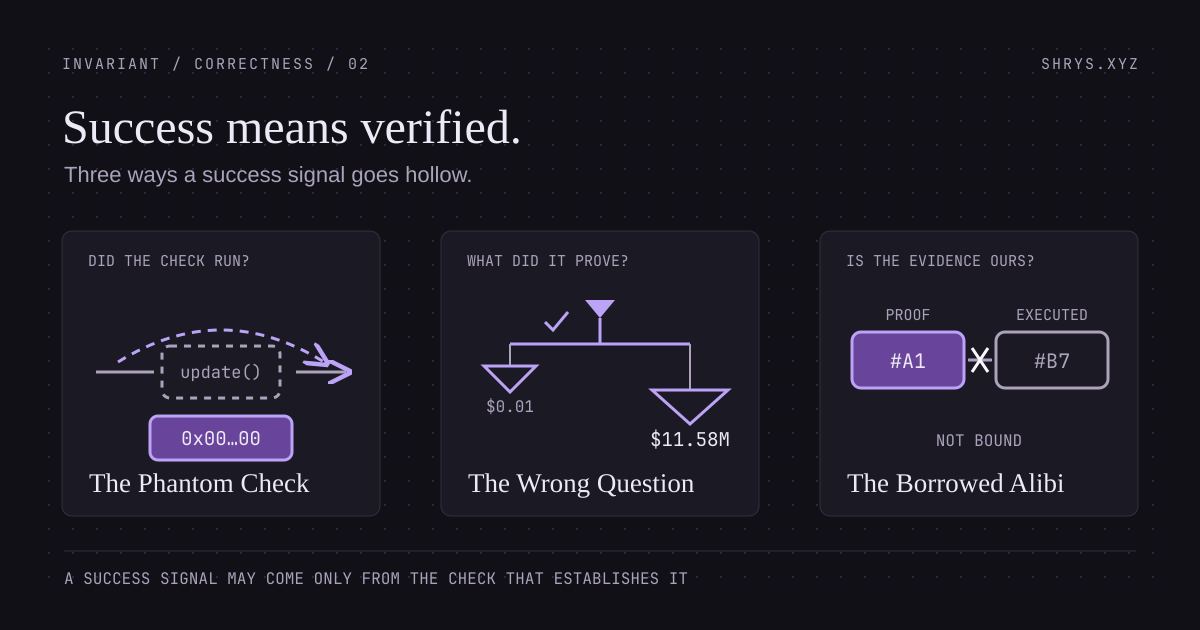
A crypto library, a cross-chain bridge, and an AI agent all reported success they had never verified. Three ways the wiring between a check and its success signal comes apart—and the rules that hold it together.
Read the article ↗Follow one request from tokens and learned weights to a tool call, a database write, and evidence of success—with a probability playground and an animated failure trace.
Building the OpenWhisk resource APIs, separating HTTP clients, and making request failures available to Rust callers.
My architecture and implementation work on NEAR bridge contracts, from routing and callbacks to token controls and storage deposits.
Built TOON’s Rust implementation from the format specification, separating parsing and validation from a typed Serde API and interactive tools.
Rearchitected an outdated Cosmos application and guided its rewrite, updating the SDK foundation, validator rewards, deterministic processing, and network-specific signing.
Turned recurring blockchain deployment problems into Kurtosis workflows for nodes, contracts, and bridges, with ordered setup and reuse of running infrastructure.
Shaped the desktop architecture and built tools for music producers, including project search, key and tempo matching, waveform trimming, and missing-sample detection.
On making engineering decisions understandable, learning from first principles, and keeping a record worth returning to.